Chaos Is the Punchline: How 'Unhinged' Comics Blew Up the Comedy Rulebook
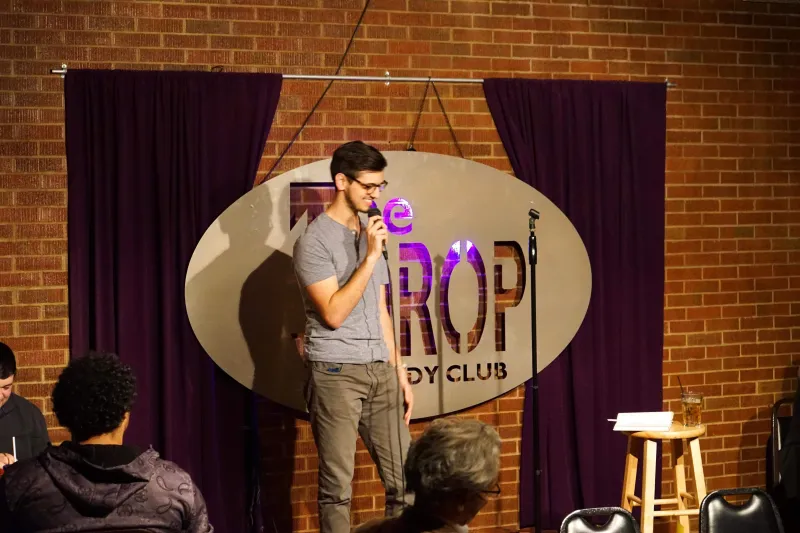
Photo: comedian performing stand-up on stage with phone camera crowd laughing, via miro.medium.com
There's a very specific kind of comedy special that used to signal you'd made it. Soft lighting. A tailored blazer. A story about your dad that starts funny and somehow ends in tears. The audience applauds like they're at a TED Talk. Credits roll. Everybody goes home feeling vaguely improved.
Gen Z watched all of that and collectively said: hard pass.
What's replacing it is louder, messier, and significantly less concerned with your approval — and it's pulling in audiences that traditional comedy bookers would've killed to reach. Welcome to the era of the unhinged comedian, where the rougher the edges, the bigger the following.
The Polish Problem
Here's the thing nobody in the industry wanted to say out loud for a long time: overly produced comedy can feel fake. Not fake like a prop, but fake like a LinkedIn post where someone calls getting fired a "growth opportunity." Audiences — especially younger ones — have a finely tuned radar for performance that's been sandpapered into something safe.
Andrew Schulz figured this out before most. Rather than waiting for a network to hand him a special, he self-distributed, kept the crowd reactions raw, and leaned hard into material that made publicists sweat. Love him or loathe him, the man built a genuinely massive independent comedy empire by treating gatekeepers like a suggestion rather than a requirement. His Flagrant podcast pulls numbers that cable shows would envy, and he did it without ever really asking permission.
"The industry wants you to be funny in a way that's also comfortable for the industry," one rising stand-up comic — who asked to stay anonymous because, as they put it, 'I still want festival spots, I'm not stupid' — told us. "That's not the same thing as being funny for the audience."
TikTok Turned the Green Room Into a Living Room
If Schulz represents the podcast-and-self-distribution wave, TikTok represents something even more chaotic: the complete elimination of the middle step. Creators like Chrissy Chaos built followings not by refining a tight five over years of club sets, but by posting whatever was careening through their brain at that exact moment — and trusting that someone out there was careening right along with them.
And someone was. Millions of someones, actually.
The appeal isn't just relatability, though that's part of it. It's the texture of authenticity — the stumbled word, the weird tangent, the bit that almost doesn't land and then somehow does. That texture signals real person in a media landscape that has, for decades, been aggressively smoothing real people into content-delivery systems.
We talked to Dani R., 24, a marketing coordinator in Austin who describes her comedy consumption as "basically all TikTok and podcasts now." She put it simply: "If it looks like it cost a lot of money, I already don't trust it as much. I know that sounds backwards. But like — who is that for?"
When 'No Filter' Is Actually Just 'No Thought'
Here's where Faco's Crusam has to get a little real with you, because we promised no filter and we meant it.
Not every comedian who calls themselves "unhinged" is actually pushing any kind of boundary. Some of them are just being mean and calling it brave. There's a meaningful difference between comedy that makes you uncomfortable because it's true and comedy that makes you uncomfortable because it's cruel — and the unhinged aesthetic has given some pretty mediocre comics cover to blur that line.
The bit that punches down at someone with less power and then hides behind "I'm just saying what everyone thinks" isn't transgressive. It's lazy. Real boundary-pushing comedy makes everyone a little nervous, including the person telling the joke. The best unfiltered comics — the ones actually building lasting audiences — tend to understand this distinction even if they'd never frame it that way in an interview.
"There's a difference between raw and reckless," comedian Marcus Teel, who performs in Chicago and has a growing YouTube presence, told us. "Raw means you're being honest. Reckless means you're using honesty as an excuse not to think."
The Backlash Industrial Complex
Of course, none of this plays out without controversy, and the controversy is — let's be honest — part of the engine. Every time a major media outlet writes a concerned think-piece about an unhinged creator, that creator gains fifty thousand new followers from people who want to see what all the fuss is about.
This creates a genuinely weird dynamic where the backlash is essentially free marketing, which means creators have an incentive to keep poking the outrage machine, which means the machine keeps running, which means... everyone's kind of stuck in a loop. The creator gets attention. The critics get engagement. The audience gets a front-row seat to a very public argument about what comedy is allowed to be.
Whether that's a feature or a bug depends entirely on where you're sitting.
What Comes Next
The interesting question isn't whether unhinged comedy is here to stay — it clearly is, at least in some form. The interesting question is what happens when it becomes the establishment. When Netflix starts signing the raw TikTok comics. When the moody-lit special is replaced by a moody-lit "anti-special" that's actually just as carefully produced, but aesthetically disheveled.
Some of that is already happening. And some of those comics are navigating it well, holding onto the thing that made them interesting in the first place. Others are getting polished whether they want to be or not, because that's what distribution at scale tends to do.
For now, though, the chaos is still real enough to be fun. And honestly? After years of comedy that felt like it had been approved by a committee, a little chaos is exactly what the punchline needed.